Drawing Ideas: What to Draw When You’re Out of Ideas (A Real Guide)
You opened a sketchbook. You stared at it. You closed it. You opened Pinterest. You closed Pinterest. You typed “things to draw” into Google. You got a list of 100 items that includes “a banana”, “a flower”, and “your favorite cartoon character”. You closed that too.
Welcome. We’ve all been here. Your problem isn’t that you don’t know what objects exist in the world. Your problem is that nothing on the list pulls you.
So this is going to be different. Less list, more system. By the end you’ll have several reliable ways to get unstuck, and yes, there is a real list of 50+ things to draw at the end, grouped by mood, not by random object dump.
👋 However, if you really just want the answer to “why should I draw” check my DRAWING IDEAS GENERATOR:

1. The “blank page” problem is actually a “wrong question” problem
When you ask “what should I draw?”, your brain treats it like a shopping question. It tries to pick an object from an infinite shelf. Of course nothing feels right. There are too many objects and none of them have any emotional weight.
The fix is to change the question. Instead of:
ask one of these:
2. The pocket rule: draw whatever was just in your hand
Look at the last 24 hours. What did you physically touch?
A mug. A receipt. Your phone charger. A hair tie. A piece of bread. Your headphones tangled into a knot. Your keys.
Draw that. Draw your mug, the one with the chip on the rim, sitting where you left it, with the spoon at the angle it’s at right now.
Why this works comes back to something Miyazaki said in his 2009 essay collection Starting Point: an animator’s job is to “fabricate a lie that seems so real, viewers will think the world depicted might possibly exist.” The only way to draw a believable anything is to start from something you’ve actually touched. (I went deeper on this idea in the Ghibli aesthetic breakdown. Miyazaki paints food he’s personally cooked. Same principle.)
3. Hokusai’s 100 views trick

Katsushika Hokusai – the guy who painted The Great Wave – didn’t draw “a wave”. He drew Mount Fuji from 36 different angles, and then loved it so much he added 10 more and called the next set One Hundred Views of Mount Fuji. Same mountain. A hundred times.
In the famous postscript to that book, Hokusai wrote (translated, but the gist is right):
He’s saying: you don’t run out of a subject — you run out of patience with it. The boredom you feel after drawing the same kettle twice is not “I’ve mastered this kettle.” It’s “I haven’t even started looking.”
So the trick: pick one object: your kettle, your shoe, the view from one window, your left hand, and draw it 10 times in 10 different ways. Different angle. Different time of day. Different medium. Different scale. With shadows, without. From memory, from life. Tiny, huge.
4. The two-random-words generator (the surrealist version)
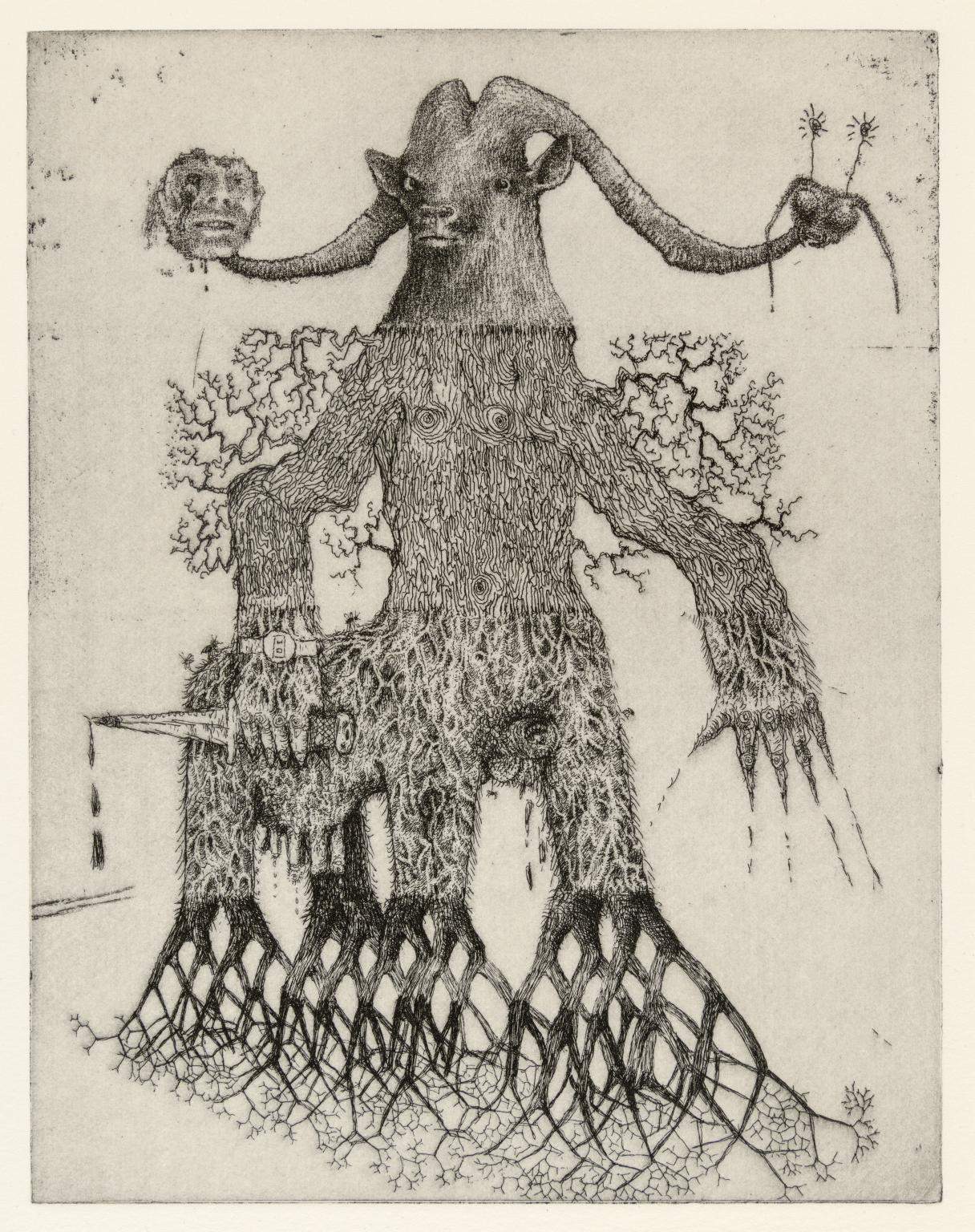
Exquisite Corpse (2000)
Tate
© Jake and Dinos Chapman
The surrealists in 1920s Paris invented a game called cadavre exquis (“exquisite corpse”). You’d fold a piece of paper, each person drew a part of a figure without seeing the other parts, and you unfolded it to get a beautiful monster. The point was to bypass the conscious brain.
You can do a one-person version. It works like this:
- Open any book, close your eyes, point at a word. Write it down.
- Do it again with a different book. Write the second word.
- Draw the combination.
The two-word constraint is what makes this work. Your brain cannot generate a generic answer because the pair doesn’t exist yet. It has to invent something. That’s where ideas come from.
Pro tip: for slightly weirder results, use one concrete word (something you can touch) and one abstract word (a feeling, a sound, a season). “Toothbrush + loneliness.” “Cucumber + thunder.”
5. Steal from dead people (a.k.a. the public domain goldmine)

There are millions of beautiful, weird, free, copyright-free reference images on the internet right now and most artists don’t know they exist. Here’s where to actually go:
- Smithsonian Open Access — si.edu/openaccess — 4.5+ million images, including specimens, instruments, costumes, weird Victorian objects you’ve never seen.
- Rijksmuseum — rijksmuseum.nl — Dutch masters at high resolution. Download a Vermeer and steal the light.
- NYPL Digital Collections — digitalcollections.nypl.org — vintage menus, old maps, theater costumes, ephemera, hand-drawn botanicals.
- The Met Open Access — metmuseum.org/art/collection — 490,000+ images, every era, every culture.
- Internet Archive — archive.org — scanned books from before 1928 are mostly public domain. Search “1890 fashion plates” or “Edwardian botanical”.
- Biodiversity Heritage Library — biodiversitylibrary.org — vintage scientific illustrations of every plant, bug, and fish ever drawn by a 19th-century Victorian with too much patience.
What to do once you’re there: pick something weird and old. A 1750 anatomical drawing of a hand. A Japanese woodblock print of a fox. A Dutch still life with a cracked lemon peel. Don’t copy it. Use it as a starting point — redraw it in your own style, in modern clothing, in a different season, on Mars. The reference gives you the bones. You add the soul.
6. Draw the boring thing, but weirdly
A radiator is boring. A radiator from the perspective of an ant on the floor, lit by sunset through a yellow curtain, is not boring. Same radiator. Different seeing.
The hack: pick the most banal object near you right now. Then change exactly one parameter:
🔹 Scale. Draw a paperclip the size of a building.
🔹 Perspective. Draw your room from the ceiling looking down.
🔹 Lighting. Draw your kitchen as if it’s lit only by the open fridge.
🔹 Material. Draw your phone but made of stone. Or fabric. Or fruit.
🔹 Time. Draw the same window at 5am, noon, 8pm, 2am.
🔹 Weather. Draw your living room flooded with water up to the couch cushions.
🔹 Inhabitant. Draw your bathroom — but a frog lives there now, and has rearranged things.
Boring objects become interesting the moment you introduce one wrong element. This is the entire engine behind shows like Adventure Time and half of Studio Ghibli.
7. Use emotion as the starting point, not the object
Most “things to draw” lists give you nouns. Cat. Tree. Sword. But trained artists usually start with a feeling, and the object follows.
Try these prompts (pick one and don’t think too hard):
- Draw the feeling of the last day of summer.
- Draw what being eight years old in your grandmother’s kitchen looked like.
- Draw the moment right before you fall asleep.
- Draw the loneliest hour of the week.
- Draw what a good Tuesday feels like.
- Draw the smell of rain on hot pavement (yes, draw a smell).
- Draw the sound of your fridge at 3am.
When you start from a feeling, the objects you need announce themselves. You’ll know the room has yellow curtains. You’ll know the cat is asleep on the chair. You don’t have to pick from a list – the feeling picks for you.
This is also, by the way, how most great illustrators work. They’re not drawing things. They’re drawing atmospheres, and the things are just whatever happens to be standing in that atmosphere.
8. The actual list of things to draw (grouped by mood, not random)
Okay, fine. Sometimes you just need a list. But not that list. Here’s one organized by feeling, so you can pick the row that matches your mood today.
Domestic / quiet things
- The contents of your bag, laid out flat
- A half-eaten meal on a plate
- Your unmade bed, exactly as it is
- Laundry hanging to dry (steal from Ghibli — they love this)
- A windowsill with stuff on it
- Your hand holding something familiar
- The corner of a room where two walls meet
Memory things
- The kitchen of someone who raised you
- Your childhood bedroom from memory (don’t check a photo)
- A specific birthday you remember
- The first toy you remember loving
- The view from a window of a place you don’t live anymore
- A meal someone made for you that you can’t make yourself
Weird small things
- A houseplant that’s dying
- A pile of receipts
- A drawer of tangled cables
- Coins on a counter
- A crumpled napkin
- Bread crumbs on a tablecloth
- Your shoe, alone, in the hallway
Weather things
- A puddle reflecting a sky you wish was real
- Steam rising from a manhole
- Rain on a bus window
- Fog where you can only see the outline of trees
- Heat shimmer on a road
- Snow on something that doesn’t usually have snow on it (a bike, a chair, a cat)
Strangers
- The back of someone’s head on a train
- An old man feeding pigeons
- Two teenagers sharing earbuds
- Someone asleep on public transport
- A waitress on her smoke break
- A child carrying something too big
Liminal places
- A hallway at 3am
- A motel parking lot at dusk
- An empty mall
- A train platform with no train
- A closed pool in winter
- A waiting room
- An empty playground
Bodies
- Your own non-dominant hand
- Feet — yours, in your own shoes
- A face from 3/4 view, eyes closed
- A back, from behind
- Hair, very specifically — like a portrait of just hair
- Knuckles, individually
Childhood / nostalgia
- A 90s television set
- A cassette tape
- A handful of stickers
- A specific snack you don’t see anymore
- Your old school’s gym
- The plastic chair in a doctor’s office
- A swimming float
If even one of these caused a tiny “oh” in your chest — that’s the one. Draw that one.
9. References vs. imagination (and why “drawing from imagination” is a trap people sell you)
There’s a weird internet myth that real artists draw “from imagination” and using references is cheating. This is nonsense and you can stop carrying it around.
Every artist you respect uses references. Every one. Studio Ghibli builds physical scale models. Disney animators film themselves acting out scenes. Norman Rockwell took photographs of his neighbors. Da Vinci dissected bodies. The “imagination only” thing is a beginner trap – what people mean by “drawing from imagination” is actually drawing from a deep internal library of observed reference. Which is just references that you’ve memorised.
So if you don’t have that internal library yet use external references constantly, and without shame. That’s how you build the library. In ten years you’ll be able to draw a hand from memory because you drew 4,000 hands from photos.
Practical workflow for getting ideas using references:
- Pick a feeling or pair of words (sections 4 and 7).
- Find 3–5 reference images that match the vibe (sections 5).
- Sketch thumbnails combining elements from each.
- Pick the best thumbnail. Now you have something to draw.
This is how professional concept artists generate work every day. There’s no shame in the system — the system is the skill.
10. What to do when nothing works
Sometimes all of the above will fail. That’s also fine. When it does, here’s the protocol:
- Close the sketchbook for 20 minutes. Don’t scroll. Don’t look at art.
- Take a walk without headphones. Look at things. Don’t photograph them. Just look.
- Make a hot drink. Watch the steam.
- Open the sketchbook. Draw the cup. Don’t draw anything else. Just the cup.
This works because the problem isn’t a shortage of ideas — it’s a shortage of attention. Walks restock attention. The cup is just the excuse to start. Once you’re 5 minutes into the cup, you’ll remember a thing you saw on the walk, and now you actually have something to draw.
If even that doesn’t work — take the day off. Drawing isn’t a moral test. It’ll be there tomorrow. ☕
So what does this all mean for “what to draw”?
The TL;DR if you skimmed everything:
- Stop asking “what to draw”. Ask “what did I notice”.
- Draw what was in your hand in the last 24 hours. Specific, not generic.
- Pick one thing and draw it 10 times. Hokusai was right.
- Use the two-random-words trick when you need a spark.
- Steal from the public domain. Smithsonian, Rijksmuseum, NYPL, Met, Internet Archive.
- Take a boring object and change one parameter — scale, lighting, material, time, weather.
- Start from a feeling, not a noun.
- Use references shamelessly. That’s how you build imagination.
- When nothing works, walk, then draw a cup.
Drawing ideas aren’t out there on a list. They’re in the last week of your life, the last hour of your attention, and whatever you almost took a photo of but didn’t. Go look.
Did You Like it?
I’d love to make this article (and the Ghibli aesthetic + Ghibli color analysis ones) part of a bigger ebook with a super-comprehensive guide to building a personal drawing practice — finding ideas, observing better, painting like Ghibli, the whole thing in one place.
So, if you’d like to show me your support and think such an ebook is a nice idea:
- DM me: Instagram, TikTok, Cara
- Email me: mlecznymleczart@gmail.com
- Or sign up for the newsletter!
Drawing Practice Ebook [WAITLIST]
Signup for the ebook updates & get a message once it’s OUT!
Self-taught digital painter who likes to write about art & drawing. Mostly painting urban scenes during golden & blue hour.